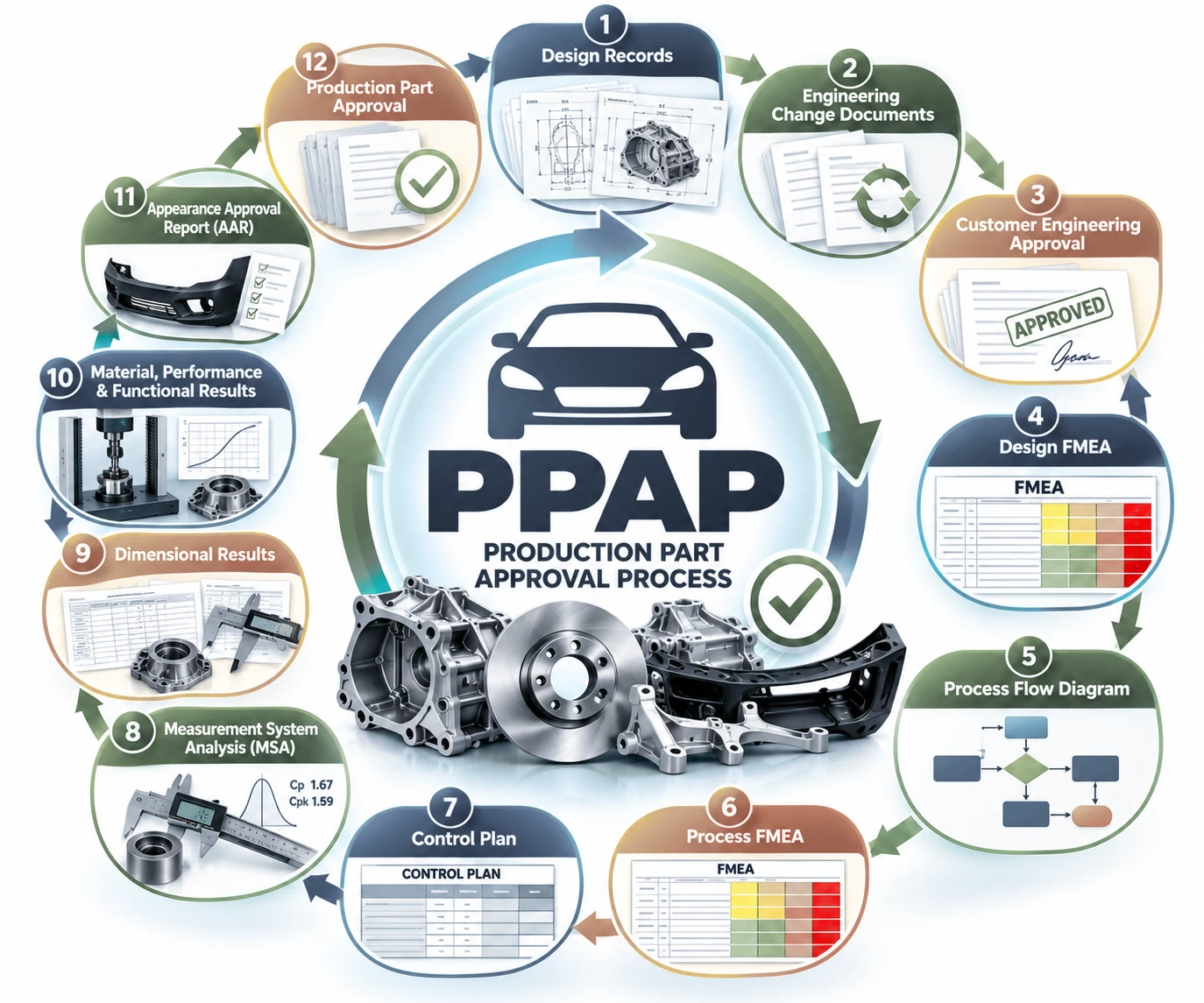
The Production Part Approval Process (PPAP) is the industry-standard verification method used in automotive, aerospace, and precision engineering sectors to establish customer confidence in a supplier's manufacturing process and capability.
The purpose of PPAP is to provide evidence that all customer engineering design records and specification requirements are properly understood, and that the manufacturing process has the potential to produce product consistently meeting these requirements during an actual production run at the quoted production rate (Run-at-Rate).
At SriWin, our consulting and hands-on workshops guide engineering, quality, and production teams through compiling and validating the complete 18 PPAP elements. From ballooned drawing ballooning and full dimensional layouts to MSA studies, capability analyses, and final Part Submission Warrant (PSW) sign-offs, we ensure your submissions meet Tier-1 and OEM standards on the first attempt.
Establishing traceable design records, CAD models, and ballooned 2D engineering drawings identifying all dimensions and critical characteristics.
Ensuring complete three-way alignment between the Process Flow Diagram (PFD), Process Failure Mode and Effects Analysis (PFMEA), and the Production Control Plan.
Full dimensional layout reports verifying every feature, geometric tolerance (GD&T), and note identified on the ballooned engineering drawing.
Documented chemical, physical, and metallurgical material test results (MTCs) and functional performance test verifications against OEM specifications.
Applicable Measurement Systems Analysis (MSA - Gage R&R) and initial process capability evaluations (Ppk/Cpk $\ge$ 1.67) for all special characteristics.
Preparation and sign-off of the Part Submission Warrant (PSW), sample master parts, appearance approval reports (AAR), and IMDS material submissions.
Eliminate costly submission rejections, endless revision loops, and delays in obtaining commercial production sign-off.
Prove that production tooling and machine parameters can consistently sustain peak cycle times and tolerances at quoted volumes.
Prevent assembly line bottlenecks and component fitment failures when introducing new tooling, materials, or manufacturing locations.
Build strong working relationships with automotive and industrial customers by adhering strictly to AIAG manuals and customer-specific guidelines.
Detect design flaws and gage errors during pre-launch trials rather than enduring field complaints and warranty penalties.
Maintain an organized documentation dossier detailing tool life, raw material batching, master samples, and qualified inspection methods.


Work with SriWin’s automotive core tool specialists to prepare your complete PPAP dossier or train your engineering teams for first-time sign-off success.
Request PPAP Training Proposal